Beyond Multiple Choice: Measuring AI Literacy Through Authentic Assessment
Why traditional tests fail to capture AI skills, and how performance-based assessment provides meaningful insights.
Beyond Multiple Choice: Measuring AI Literacy Through Authentic Assessment
When it comes to assessing AI literacy, traditional multiple-choice tests fall short. You can't measure someone's ability to critically evaluate AI output or craft effective prompts by asking them to bubble in answers. That's why Mindapt takes a fundamentally different approach.
As an assessment researcher who has spent 15 years developing evaluation frameworks, I can tell you: the way we measure AI literacy will determine how well we teach it. Get the assessment wrong, and you'll optimize for the wrong skills. Get it right, and you'll create genuinely AI-literate students.
The Problem with Traditional AI Assessments
Many early attempts at AI literacy assessment focused on knowledge recall:
- "What does GPT stand for?"
- "Which company created ChatGPT?"
- "What year was the first neural network invented?"
- "Name three types of machine learning."
While this information might be interesting trivia, it tells us nothing about whether a student can actually work effectively with AI tools.
Why Knowledge-Based Tests Fail
Consider this analogy: you could memorize every fact about swimming—the physics of buoyancy, the names of different strokes, the history of competitive swimming—and still drown in a pool. Knowledge about a skill is not the same as possessing the skill.
AI literacy is the same way. Knowing that GPT stands for "Generative Pre-trained Transformer" doesn't help you:
- Recognize when AI output is biased
- Craft prompts that get useful results
- Decide when AI use is appropriate
- Evaluate AI-generated content critically
These are performance skills, and they require performance assessment.
What We Should Be Measuring
True AI literacy encompasses skills that require demonstration, not just recognition. Let me break down the four core competencies and what authentic assessment of each looks like:
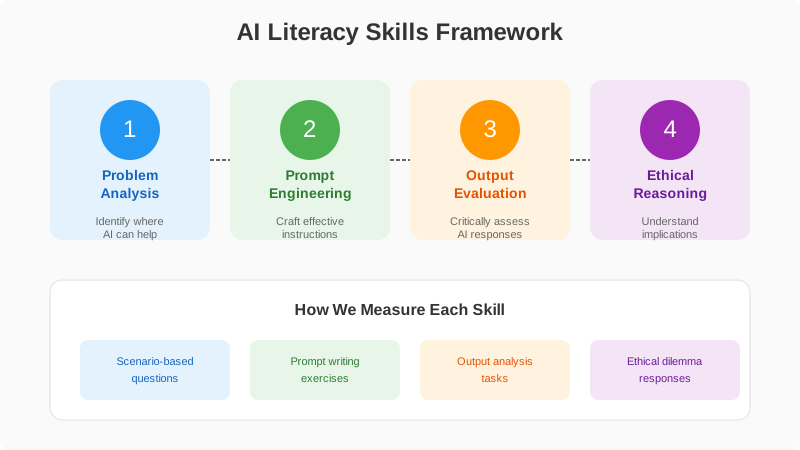
1. Problem Analysis
The skill: Identifying where AI can (and can't) add value to a task.
What we measure:
- Can the student break down complex scenarios into components?
- Can they identify which parts would benefit from AI assistance?
- Do they recognize tasks that are poorly suited for AI?
- Can they articulate why AI would or wouldn't help?
Sample assessment task: Present a student with a research project scenario and ask them to identify three places where AI could help and one place where AI would be a poor choice. They must explain their reasoning for each.
2. Prompt Engineering
The skill: Crafting effective instructions that produce useful AI outputs.
What we measure:
- Does the prompt include necessary context?
- Is the task clearly specified?
- Are appropriate constraints included?
- Does the prompt specify the desired format?
- Can the student iterate and improve prompts?
Sample assessment task: Give students a communication goal (e.g., "You need AI help writing a persuasive letter to your principal about extending lunch periods"). Evaluate the prompts they write against a rubric measuring specificity, context, constraints, and format.
3. Critical Evaluation
The skill: Assessing AI-generated content for accuracy, bias, and appropriateness.
What we measure:
- Can students identify factual errors?
- Do they recognize bias or one-sided perspectives?
- Can they spot missing context or nuance?
- Do they notice inappropriate confidence or hedging?
- Can they distinguish quality content from fluff?
Sample assessment task: Provide students with AI-generated content about a topic they've studied. Ask them to identify specific issues with the content, explain why each is problematic, and suggest how to verify or correct the information.
4. Ethical Reasoning
The skill: Understanding the implications and responsibilities of AI use.
What we measure:
- Do students understand when AI use is appropriate vs. inappropriate?
- Can they articulate attribution and disclosure requirements?
- Do they recognize privacy and data implications?
- Can they reason through novel ethical scenarios?
Sample assessment task: Present ethical dilemma scenarios (e.g., "Your friend asks you to run their college application essay through AI to 'improve' it"). Have students reason through the scenario, identify stakeholders, and defend their recommended action.
Mindapt's Assessment Approach
Our AI Assessment uses performance-based tasks that mirror real-world AI interactions. Students don't just answer questions about AI—they demonstrate their skills by:
- Analyzing a scenario and identifying where AI could help
- Crafting prompts to address specific challenges
- Evaluating AI outputs and identifying improvements needed
- Reflecting on the process and their decision-making
Each response is evaluated using carefully developed rubrics that capture the nuances of AI literacy—not just whether an answer is "right" or "wrong."
"For the first time, we can see exactly where each student's strengths and growth areas lie. The data is actionable, not just a score." — District Curriculum Coordinator
The Pre-Post Design: Measuring Genuine Growth
What makes our assessment unique is its pre-post design. Students complete the same assessment before and after the Core Course, allowing schools to measure genuine skill development—not just course completion.
Why Pre-Post Assessment Matters
Without pre-assessment, you can't distinguish between:
- Students who learned skills through your program
- Students who already had strong AI skills
- Students who improved through other means
The pre-post design provides causal evidence that your AI literacy program is actually working.
What We Track
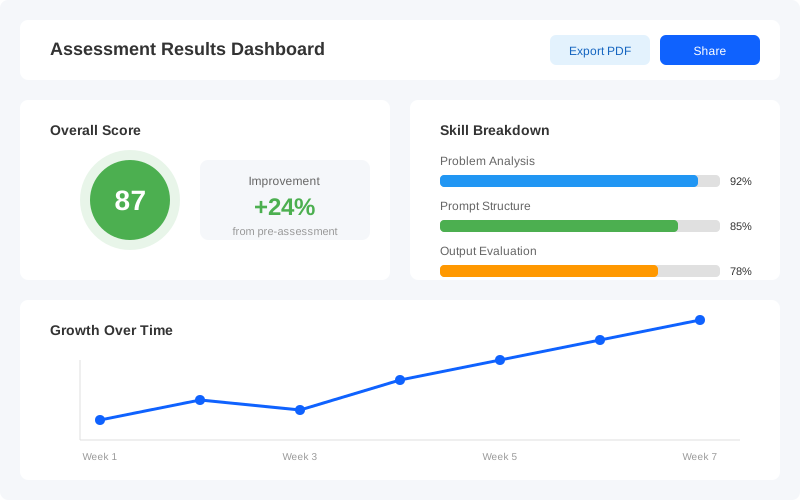
| Metric | What It Measures | Why It Matters |
|---|---|---|
| Problem Analysis Score | Ability to break down complex scenarios and identify AI opportunities | Foundation for all AI use |
| Prompt Effectiveness | Quality and specificity of AI instructions | Determines quality of AI interactions |
| Critical Evaluation | Accuracy in identifying AI output issues | Prevents over-reliance on AI |
| Ethical Reasoning | Understanding of appropriate AI use | Ensures responsible AI use |
| Overall Growth | Pre-to-post improvement across all dimensions | Validates program effectiveness |
Beyond Individual Assessment: School-Wide Analytics
While individual student assessment is valuable, Mindapt also provides school-level insights that help administrators and teachers improve their programs.
Classroom Summaries
Teachers receive reports showing:
- Class-wide strengths and areas for growth
- Common misconceptions or skill gaps
- Comparison to learning objectives
- Suggestions for targeted instruction
School-Wide Analytics
Administrators see:
- Aggregate performance across all classrooms
- Trends over time
- Comparison benchmarks against similar schools
- ROI data for board presentations
Identifying Patterns
Our analytics often reveal surprising patterns:
- Students might excel at prompt engineering but struggle with critical evaluation
- Certain topics might consistently cause confusion
- Some classrooms might outperform others—what are they doing differently?
These insights help schools continuously improve their AI literacy programs.
What Makes Assessment "Authentic"?
The term "authentic assessment" has a specific meaning in education research. For an assessment to be authentic, it must:
1. Mirror Real-World Tasks
Our assessment tasks aren't abstract exercises—they're scenarios students will actually encounter:
- Researching for a school project
- Writing with AI assistance
- Evaluating information found online
- Deciding whether AI use is appropriate
2. Require Application, Not Just Recall
Students can't succeed by memorizing facts. They must actually demonstrate skills:
- Writing prompts (not just identifying good prompts)
- Analyzing outputs (not just matching to answer keys)
- Reasoning through scenarios (not just selecting answers)
3. Allow Multiple Valid Approaches
Unlike traditional tests with one "right answer," authentic assessment recognizes that skilled performance can take many forms. Our rubrics evaluate the quality of reasoning, not just the specific conclusions.
4. Provide Meaningful Feedback
Assessment should serve learning, not just measurement. Our reports tell students exactly where to focus their development—not just whether they "passed."
Implementation: How It Works in Practice
For Students
- Pre-Assessment (30-45 minutes): Students complete the assessment before starting the Core Course. This establishes baseline skills and often reveals existing knowledge.
- Learning Phase: Students progress through the Core Course, building skills through instruction and practice.
- Post-Assessment (30-45 minutes): Students complete the same assessment after the course. Comparison to pre-assessment reveals growth.
- Results Review: Students receive personalized feedback showing their growth and remaining areas for development.
For Teachers
- Classroom Dashboard: Real-time visibility into student progress and assessment results.
- Instructional Guidance: Suggestions for addressing common gaps revealed by assessment data.
- Individual Student Support: Identification of students who may need additional help.
For Administrators
- School-Wide Reports: Aggregate data for program evaluation and board reporting.
- Benchmark Comparison: How does your school compare to similar schools nationwide?
- Longitudinal Tracking: Track improvement over semesters and years.
Evidence of Effectiveness
Schools using Mindapt's assessment-driven approach have seen measurable results:
| Outcome | Result |
|---|---|
| Average skill improvement | +31% from pre to post |
| Students showing growth | 94% |
| Teacher satisfaction with data | 4.6/5 |
| Administrator reporting ease | "Dramatically simplified" |
More importantly, teachers report that students demonstrate better AI skills in their regular coursework—the assessment is measuring something real.
Common Questions About Our Assessment
Q: Can students "game" the assessment?
A: Because our assessment requires demonstrated performance (writing prompts, analyzing outputs, reasoning through scenarios), it's much harder to game than traditional tests. You can't fake prompt engineering skill—you either can write effective prompts or you can't.
Q: How do you ensure consistency in scoring?
A: Our rubrics are developed through extensive research and tested for inter-rater reliability. We combine algorithmic scoring for some components with expert human review for others.
Q: Is the assessment accessible for students with different needs?
A: Yes. We offer accommodations including extended time, text-to-speech, and alternative formats. The assessment is designed to measure AI literacy skills, not reading speed or typing ability.
Q: How often should students be assessed?
A: We recommend pre-assessment before the course and post-assessment after completion. Some schools also use mid-point checks. Annual reassessment can track long-term retention.
The Future of AI Literacy Assessment
As AI tools evolve, so must our assessment approaches. We're continuously researching:
- How to assess skills with emerging AI capabilities
- Longitudinal tracking of AI literacy development
- Cross-cultural validity of assessment frameworks
- Integration of AI literacy assessment with other competencies
Assessment isn't just measurement—it's a signal that shapes learning. By measuring the right skills in the right ways, we help ensure students develop genuine AI literacy, not just AI familiarity.
See It In Action
Want to see what authentic AI literacy assessment looks like?
- Download a sample student report — See the detail and actionability of our feedback
- View sample administrator dashboard — Explore school-wide analytics
- Book a demo — Experience the full assessment firsthand
The way we measure AI literacy will shape how the next generation learns to work with AI. Let's make sure we're measuring what matters.