Prompt Engineering 101: Teaching Students to Communicate with AI
A beginner's guide to helping students craft effective prompts that produce useful, accurate AI outputs.
Prompt Engineering 101: Teaching Students to Communicate with AI
The difference between a frustrating AI interaction and a productive one often comes down to a single skill: prompt engineering. Teaching students how to communicate effectively with AI is one of the most valuable skills we can offer them today.
Think about it this way: AI tools are incredibly powerful, but they're also incredibly literal. They don't know what you really mean—they only know what you actually say. Prompt engineering is the bridge between your intent and the AI's understanding.
What is Prompt Engineering?
Prompt engineering is the art and science of crafting instructions that help AI tools understand exactly what you need. Think of it like giving directions—the clearer and more specific you are, the better the result.
But it's more than just being clear. Good prompt engineering involves:
- Understanding how AI interprets language
- Anticipating where AI might make mistakes
- Structuring requests for optimal responses
- Iterating and refining based on results
It's a skill that transfers across all AI tools—once students learn these principles, they can apply them anywhere.
The Anatomy of an Effective Prompt
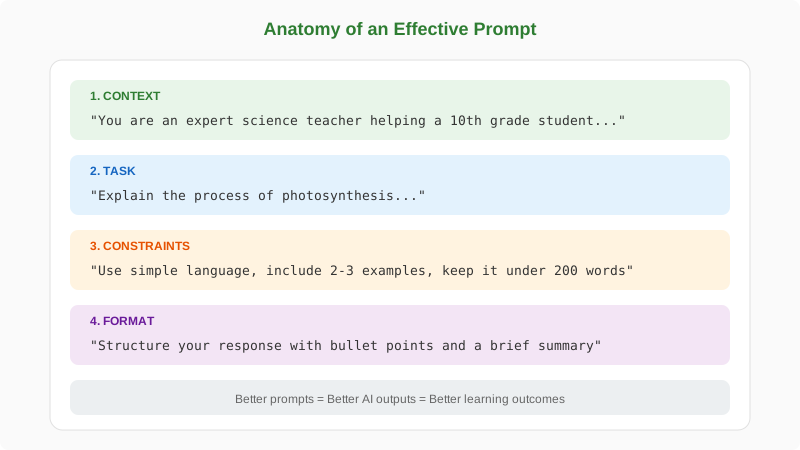
Every effective prompt contains four key elements. Think of them as building blocks that stack together:
1. Context: Set the Stage
Before asking for anything, tell the AI who it's talking to and what situation it's working within.
Without context:
"Write about photosynthesis."
With context:
"You're helping a 6th grade student prepare for a science test. They understand basic biology but struggle with chemical processes."
The context completely changes how the AI approaches the response. It will use simpler language, avoid jargon, and focus on concepts rather than memorization.
2. Task: Be Specific About What You Want
Vague tasks produce vague results. Specific tasks produce useful results.
Weak task: "Tell me about climate change"
Strong task: "Explain three causes of climate change that a 7th grader could understand, with real-world examples for each"
The second prompt defines:
- Scope: Three causes (not everything about climate change)
- Audience: 7th grade level (determines complexity)
- Format: Include real-world examples (not just abstract concepts)
3. Constraints: Define the Boundaries
Constraints prevent AI from going off-track. They're the guardrails that keep the response focused.
Examples of useful constraints:
- "Keep your response under 200 words"
- "Don't use any technical jargon"
- "Focus only on causes, not solutions"
- "Use only examples from the last 10 years"
4. Format: Specify How You Want Information Presented
AI can present information in many formats. Tell it what you need:
- "Give me a bulleted list..."
- "Write this as a dialogue between two characters..."
- "Create a table comparing..."
- "Explain this in three paragraphs..."
- "Structure this as an outline with main points and sub-points..."
Putting It All Together
Here's how a weak prompt transforms into a strong one:
Weak prompt:
"Help me with my essay about school start times."
Strong prompt:
"I'm a 10th grade student writing a persuasive essay arguing that high schools should start later in the morning. My English teacher values strong evidence and clear structure. Help me write an introduction paragraph that: (1) hooks the reader with a surprising fact about teen sleep, (2) briefly explains the current situation, and (3) ends with a clear thesis statement. Keep it under 150 words and use formal academic language."
See the difference? The strong prompt gives the AI everything it needs to produce exactly what you want.
Common Mistakes to Avoid
Students often struggle with these common pitfalls:
Mistake 1: Being Too Vague
| Vague Prompt | Better Prompt |
|---|---|
| "Tell me about World War 2" | "Summarize the three main causes of World War 2 in Europe, with one sentence about each" |
| "Help with my math" | "Explain how to solve this quadratic equation step by step: x² + 5x + 6 = 0" |
| "Write a story" | "Write a 200-word story about a student who discovers a time machine, told from first person perspective" |
Mistake 2: Accepting the First Response
The first response is rarely the best response. Teach students to iterate:
- "That's good, but can you make it simpler?"
- "Can you add an example to the second paragraph?"
- "The tone is too casual—can you make it more academic?"
- "You mentioned X—can you explain that in more detail?"
Mistake 3: Not Fact-Checking
AI can be confidently wrong. Always verify:
- Statistics and data points
- Historical dates and facts
- Scientific claims
- Quotes and attributions
"Once my students learned to iterate on their prompts, the quality of their AI-assisted work improved dramatically. They stopped accepting mediocre first responses." — Mrs. Patricia Hayes, 8th Grade Teacher
Mistake 4: Forgetting Your Audience
Generic responses don't fit specific needs. Always specify:
- Who will read this?
- What do they already know?
- What tone is appropriate?
- What level of detail do they need?
Advanced Techniques
Once students master the basics, they can explore more sophisticated approaches:
Chain-of-Thought Prompting
Ask AI to "think step by step" or "explain your reasoning." This produces more accurate responses, especially for complex problems.
Example:
"Solve this word problem, showing your reasoning at each step: A train leaves Station A at 9am traveling 60 mph. Another train leaves Station B, 180 miles away, at 10am traveling 90 mph toward Station A. When and where do they meet?"
Role-Based Prompting
Assign the AI a specific role to shape its responses:
"You are an experienced debate coach. Help me identify weaknesses in this argument and suggest how to address them."
Few-Shot Learning
Show the AI examples of what you want:
"I want to write metaphors about learning. Here are examples of the style I like:
- 'Learning is a garden—you plant seeds today and harvest tomorrow.'
- 'Learning is a muscle—it grows stronger with exercise.'
Now write three more metaphors about learning in this same style."
Practice Activities
Here are exercises to help students develop their prompt engineering skills:
Activity 1: The Transformation Challenge
Take a simple question and rewrite it three different ways, making each version more specific. Compare the AI's responses.
Starting point: "What is gravity?"
Version 1 (Add audience): "Explain gravity to a 5-year-old using only words they would know."
Version 2 (Add format): "Explain gravity in exactly three sentences, getting progressively more detailed."
Version 3 (Add context): "I'm building a science fair project about gravity. Explain gravity in a way I could put on my display board, using an analogy with something kids can relate to."
Activity 2: The Debugging Challenge
Give students a weak prompt and have them identify what's missing, then improve it.
Weak prompt: "Write about dogs."
What's missing:
- Purpose (inform? persuade? entertain?)
- Audience (who's reading this?)
- Scope (what aspect of dogs?)
- Format (essay? list? poem?)
- Length (how long?)
Student's improved version: [Have them write their own]
Activity 3: The Iteration Challenge
Give students a prompt and have them refine it through three rounds of iteration based on AI responses, documenting what they changed and why.
The Prompt Lab
Mindapt's Prompt Lab provides a safe environment for students to practice these skills:
- Compare different prompting approaches side-by-side
- See how small changes affect AI responses
- Get feedback on prompt effectiveness
- Build a personal library of effective prompts
Students learn not just what works, but why it works—developing intuition they can apply to any AI tool.
Why This Matters
Prompt engineering isn't just about getting better AI responses. It's about:
- Clear communication: Articulating exactly what you need is valuable everywhere
- Critical thinking: Anticipating problems and ambiguities
- Iterative improvement: Refining work based on feedback
- Understanding AI: Knowing what these tools can and can't do
These skills transfer far beyond AI interactions. Students who learn to communicate clearly with AI become better communicators overall.
Try It Yourself
Here's a challenge to take back to your classroom:
The "Better Than Generic" Challenge
- Ask AI a simple question and get a generic response
- Rewrite the prompt using the four elements (context, task, constraints, format)
- Compare the responses
- Reflect: What specific changes made the biggest difference?
Have students share their best prompts and discuss what made them effective.
Ready to Get Started?
Mindapt's curriculum includes comprehensive prompt engineering training through our Prompt Lab and Core Course. Students don't just learn the theory—they practice with real scenarios and get feedback on their progress.
Explore the Prompt Lab or book a demo to see how we help students master AI communication.